
It’s a new year, and if you’re thinking about buying, selling, or investing in Ottawa real estate, you’re probably wondering what lies ahead.
Will prices finally break out? How are government job cuts shaping the market? Is this the year to make your move, or should you sit tight?
We sat down with Paul Rushforth to get his expert perspective on what 2026 holds for the Ottawa housing market.
Paul has been studying this market for over two decades, and his predictions are consistently grounded in real data and real experience from selling 600 to 700 homes a year.
Here’s what he had to say.
TL;DR Summary
2025 surprises: Federal job cuts turned a promising year into a Q4 stall, leaving Ottawa’s market flat at just 3% price growth.
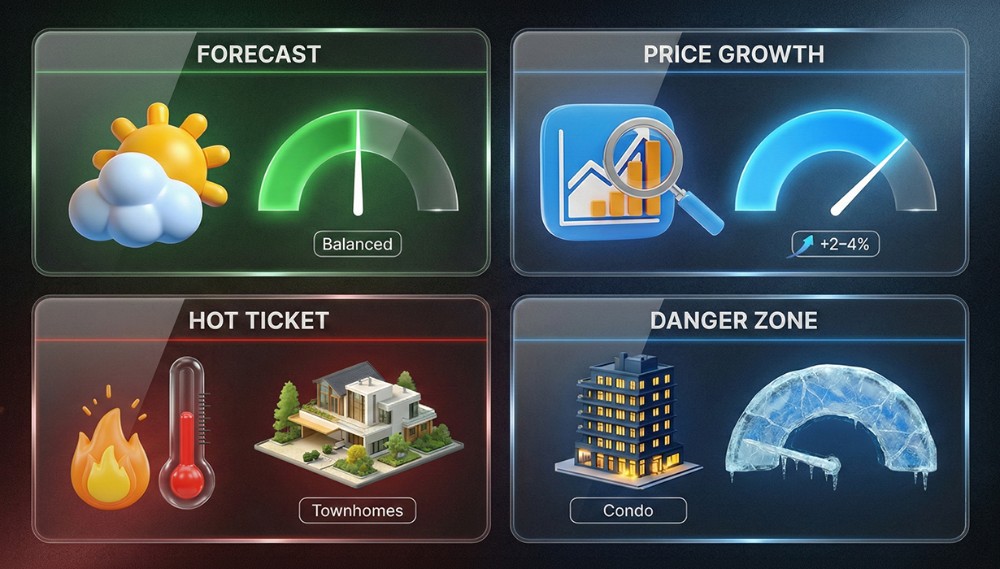
2026 market type: Expect a seller’s market under $700K, a balanced market from $700K to $1M, and a buyer’s market above $1M.
2025 vs. 2026: Another flat year in the 2 to 4% range, with a proposed HST rebate for first-time buyers on new builds, potentially saving up to $130,000.
Property types to watch: Townhouses will lead the way, single-family homes will stay flat, and condos will continue to struggle.
Government job cuts and tariffs: Both are keeping buyers and sellers on the sidelines, and the effects could last into 2027.
New rules and policy changes: Ottawa’s upcoming zoning overhaul and the proposed HST rebate are the two biggest developments to watch.
Interest rates: Rates will likely hold at 2.25%, and even a quarter-point hike would put an absolute pin in this market.
Neighbourhood pricing: Property type matters more than postal code, and record-high inventory is giving buyers more leverage than they’ve had in years.
Where investors should look: The outskirts of Ottawa offer the best cash-flow positive opportunities right now.
Investor advice: Match your strategy to your goals, whether that’s monthly income on the outskirts or long-term appreciation in the core.
Demographic trends: Millennials want small, compact, and zero-maintenance homes, and builders are following their lead.
Buyer and seller advice: Buyers have the upperhand. For sellers, pricing, presentation, and the right agent are non-negotiable.
Choosing an agent: In a market where many listings fail, the agent you choose may be the single biggest factor in your success.
1. What big surprises were you shocked to see in 2025 regarding the Ottawa market?
The year started with genuine optimism.
Interest rates were coming down, Ottawa home prices had levelled off from their 2022 and 2023 peaks, and conditions were lining up for a strong market.
And for the first half of the year, that’s exactly what happened. From about January through August, Ottawa was humming along with decent, typical activity.
Then, the wheels fell off.
When the federal budget announced that the public service would shrink by roughly 16,000 positions over three years, the market shifted almost overnight. People who were actively looking to buy or sell pumped the brakes.
In a government city like Ottawa, that kind of uncertainty hits differently. Q4 went from what should have been a solid finish to a very, very weak close.
The final numbers reflected that stall.
For sales, the year-to-date average price was up just 3%, and the year-to-date sales rose only 1.5% compared to this time last year (OREB, 2025).
This was not the rebound many had hoped for, and a reminder that Ottawa’s real estate market is deeply tied to the health of the federal workforce.
2. What kind of real estate market do you see in 2026? Buyer? Seller? Balanced?
| Price Range | Market Status | Who holds the power? | Strategy |
|---|---|---|---|
| $0 – $700k | 🟢 Slight (Seller’s Market) | Sellers | Be ready to move fast. Affordability is king here. |
| $700k – $1M | 🟡 Balanced | Neutral | Well-priced homes sell; overpriced homes sit. |
| $1M+ | 🔴 Cold (Buyer’s Market) | Buyers | Negotiation power is high. Take your time. |
Paul says that 2026 will feel like a balanced market on average, but the experience will be very different depending on your price point.
He sees the market splitting into three distinct segments:
$0 to $700,000
This range will likely be a seller’s market.
Affordability is driving demand here, especially among first-time home buyers and those looking for townhomes in the suburbs.
$700,000 to $1 Million
Expect a balanced market for this range.
Buyers will have options, but well-priced and well-presented homes will still move.
$1 Million +
This is where conditions shift firmly into buyer’s market territory.
With the rising cost of living, fewer buyers can comfortably play in this range. If you get into the $1.3 to $1.5 million bracket, it becomes a very strong buyer’s market.
3. How will the 2026 real estate market compare to 2025?
Paul predicts another flat year for Ottawa, which means price growth in the 2 to 4% range.
That’s still healthy compared to volatile markets like Toronto and Vancouver that swing 10% up and 10% down, but there won’t be any home runs in 2026.
The biggest shift for new builds is the proposed HST rebate for first-time home buyers.
Both the federal and Ontario governments have proposed measures that, once enacted, could save eligible first-time buyers up to $130,000 (up to $80,000 in tax relief from the Ontario government) on new homes valued up to $1 million.
That’s a potential game-changer for the townhouse and new-build market, and should drive real activity once the legislation is finalized.
Rentals remain a challenge, though.
More people are looking to rent than there are available rental properties, particularly on the outskirts of Ottawa, where affordability is pushing tenants further from the core.
Investors looking to decide between selling or renting out their property should take note of the strong rental demand.
4. What kind of property do you think will make the biggest impact in 2026?
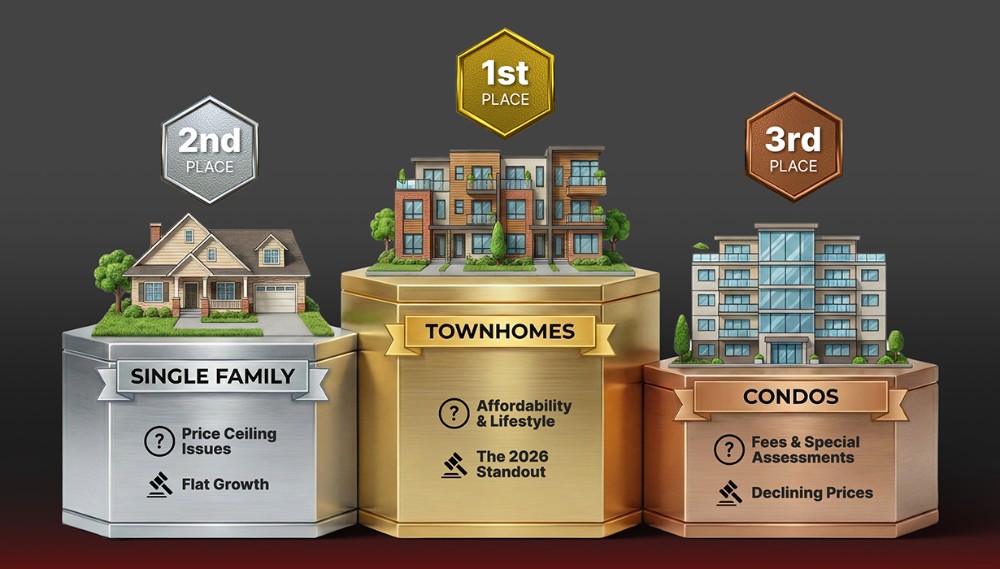
In 2025, the townhouse market led in the number of sales, while single-family homes led in average price growth. The condo market, on the other hand, struggled significantly, with apartment benchmark prices declining year over year.
Paul expects those trends to sharpen in 2026.
He predicts townhouses to be the standout performer, with affordability being the driving force.
Before COVID, $700,000 bought you a really nice single-family home in Ottawa. Now, that same budget gets you a townhome. Builders have taken notice and are shifting their focus to higher-density, smaller-footprint products that today’s buyers actually want.
Single-family homes will likely remain somewhat flat, as fewer buyers can stretch into that average price range.
Condos remain a real concern. Elevated condo fees, high per-square-foot prices, and the unpredictability of special assessments continue to weigh on this segment. Paul expects the condo market to decline again in 2026.
Toronto’s condo crisis, where thousands of planned units have stalled because builders can’t secure enough pre-sales, is starting to influence Ottawa as well. Condos will drag the overall numbers down while townhouses pull them up.
5. How have government job losses and US tariffs/economy impacted the market?
Job losses and US tariffs are the two biggest external pressures on Ottawa’s housing market right now.
The federal workforce reductions have created a cloud of uncertainty that could linger for years. With cuts expected to continue through 2029, many government workers are hesitant to make major financial decisions.
That caution ripples through the entire market, since when first-time home buyers pause, it stalls the chain for move-up buyers and downsizers alike. Paul believes we could be in for a stagnant market in both 2026 and 2027 as a result.
U.S. tariffs have added another layer of hesitation. Industries like lumber, steel, and manufacturing are feeling the squeeze, and many of those business owners are in the million-dollar-plus buyer range.
When tariffs signal uncertainty, people pause, and when people pause, the market slows.
Ottawa has weathered storms before, from COVID to tornadoes, and it will weather this one, too. But the reality is that both of these factors are keeping some buyers and sellers on the sidelines heading into 2026.
6. Have any new rules or election promises been announced that could impact the 2026 market?
The biggest development is Ottawa’s drafted zoning bylaw.
The new rules would allow up to four units on every serviced residential lot and raise height limits to three storeys across almost every neighbourhood, including the low-density suburbs. Coach homes, additional units, and more density would be permitted in areas that previously allowed only single-family dwellings.
This could be a polarizing change.
Homeowners in top Ottawa neighbourhoods like Alta Vista and Vanier with large lots could see significant redevelopment potential, with some properties able to accommodate multiple units. It’s great news for housing supply, but not everyone is thrilled about higher density next door.
On the affordability front, the proposed HST rebate for first-time home buyers on new builds could remove up to 13% in tax on qualifying homes. That legislation is working its way through Parliament and is expected to be enacted in 2026.
Beyond those two major shifts, there’s nothing else on the horizon that should dramatically alter the landscape this year.
7. How could changes in interest rates affect the Ottawa housing market in 2026?
Interest rates have an outsized effect on Ottawa’s market.
About a third of the market consists of first-time homebuyers, and another 10 to 15% consists of investors. Both groups are extremely sensitive to rate changes.
Paul doesn’t expect a major movement in 2026.
The Bank of Canada‘s policy rate currently sits at 2.25%, and while there may be a modest cut, a hike seems unlikely.
This means the market will likely hold steady without any rate-driven momentum. Every time rates dropped in 2025, the market picked up. Every time the Bank of Canada held rates, optimism faded.
But here’s the critical point: even a quarter-point increase would put an absolute pin in this market.
It would push first-time buyers further to the sidelines and keep investors away from properties that are only marginally cash flow positive. A quarter point moves a significant chunk of Ottawa’s buyers in or out of the market.
On the flip side, any drop creates an immediate surge of optimism and activity. For now, the rate expectation is to hold, which means the market will need to find its energy elsewhere.
8. Are you seeing any rise or decrease in Ottawa home prices and popularity in specific Ottawa neighbourhoods? What about the outskirts?
Overall, Paul expects the townhouse market to see the biggest average price increase this year, while the broader market stays in that flat 1-3% growth range.
There won’t be dramatic swings in specific Ottawa neighbourhood pricing, but property type will matter more than postal code.
Inventory is the defining factor, as Ottawa has more listings than it has had in years. This means buyers have a real choice, and they’re exercising it.
Feedback Paul monitors across the company consistently shows buyers saying they love a home but want to spend a couple more weeks looking around.
That abundance of choice makes what homes have sold for in your area more important than ever.
9. What areas in Ottawa should investors look into buying in 2026?
The good news for investors is that cash flow is finally becoming possible again.
With prices at reasonable levels and rates having come down from their peaks, there’s a real estate product out there that pencils out, even if the returns aren’t home runs.
Paul’s advice is to look to the outskirts.
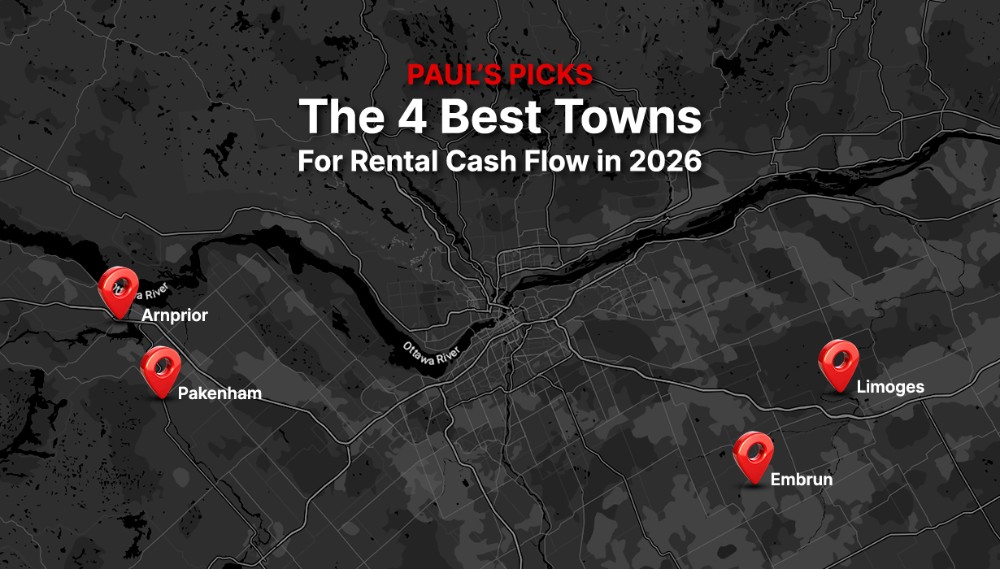
Communities like Arnprior, Pakenham, Limoges, and Embrun have strong rental demand and limited supply. A quick scan of rental listings shows more people looking to rent in these areas than there are available properties.
Core rentals remain expensive, pushing tenants outward, and investors who follow that demand can find solid, cash-flow positive opportunities.
10. Any advice for upcoming investors?
For the longest time, investors were out of the Ottawa market entirely. Nothing was cash flow positive, and dealing with tenants in Ontario has become increasingly challenging.
That’s starting to change.
Paul’s message to investors is straightforward: if you want to be cash flow positive in the Ottawa market right now, you need to look outside the core.
The outskirts offer the best combination of reasonable purchase prices, strong rental demand, and positive monthly returns. Properties in the core will cost more and may not cash flow immediately, though they can offer stronger long-term appreciation.
The key is matching your strategy to your goals.
If you want a monthly income, go where the rental demand outpaces supply. If you’re playing the long game on appreciation, higher-end urban areas may be worth the wait.
11. Do you see any trends within demographics? (First-time home buyer trouble, millennial surge, etc.)
Millennials are reshaping what gets built. The era of the 3,500-square-foot show home is fading fast.
Today’s buyers want small, compact, and low-maintenance. They want to travel, not mow lawns. Builders have pivoted accordingly, focusing on townhomes, row homes, and small singles with tiny yards. The large single-family home is becoming obsolete, and that’s not an exaggeration.
This isn’t just about affordability, though that’s certainly part of it. It’s a lifestyle choice.
Buyers are walking away from homes that need any work at all. Paul has seen people pass on a house because they didn’t like the colour of a room. That’s paint, but they don’t want to deal with it. Some of them don’t even want grass to cut.
If you visit new suburban developments across Ottawa, you’ll see townhomes, row homes, and compact singles dominating the landscape. That’s what the market wants, and that’s what’s getting built.
12. Any advice for upcoming buyers/sellers?

This is Paul’s strongest message for 2026: the days of cutting corners are over.
In years past, you could overprice your home by $10,000 or $15,000 and still get it sold. You could skip repairs, ignore presentation, or list with whoever charged the least.
That era is done.
Here’s a stat that drives the point home: based on the year’s data, Paul estimates only 51.5% of homes listed on the market actually sold in 2025.
That means nearly half of all listings failed. In a market like that, the margin for error is razor-thin.
Paul’s three non-negotiables for sellers in 2026:
Price it right.
Forensic pricing, not guesswork. The evidence needs to support your asking price, and even $5,000 to $10,000 too high can be the difference between selling and sitting.
Present it perfectly.
Your home has to show well. Buyers have more inventory to choose from than they’ve had in years, and they’re incredibly selective. There’s zero appetite for renovations among today’s buyers.
List with the right agent.
This isn’t the year to shop for the cheapest commission. You need someone who knows the market inside and out, who will give you honest advice, and who has the track record to back it up.
13. What qualities or attributes should individuals look for when selecting a real estate agent to assist them in their transactions in 2026?
2026 will be one of the most important markets in the last couple of decades for listing with the right real estate team.
With only about half of the listed homes selling last year, the agent you choose could be the single biggest factor in whether your home sells or sits.
You need someone who is educated about the market, well-connected in the industry, and willing to give you the truth about pricing and presentation, not just tell you what you want to hear.
Choose the Right Real Estate Team in 2025!
Choose the Right Real Estate Team in 2026
No one understands Ottawa housing market trends, pricing, and timing like the Paul Rushforth team.
Whether you’re buying your first home, selling in a competitive market, or investing for cash flow, our experience and commitment ensure you make the right moves in 2026.
Talk To Us About Your 2026 Ottawa Real Estate Needs: Buyer/ Seller
Paul Rushforth Real Estate is a member of the Ottawa Real Estate Board, the Ontario Real Estate Association, and the Canadian Real Estate Association.